
Part 10: わ を ん and Particles は へ

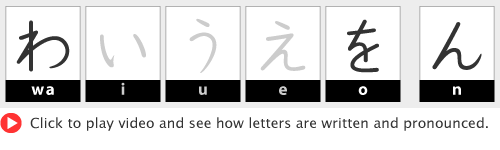
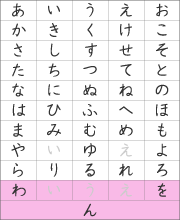
わ を belong to わ-row in the gojūon-zu (table of 46 basic letters).

ん does not belong to any row or column in the gojūon-zu.

Reading

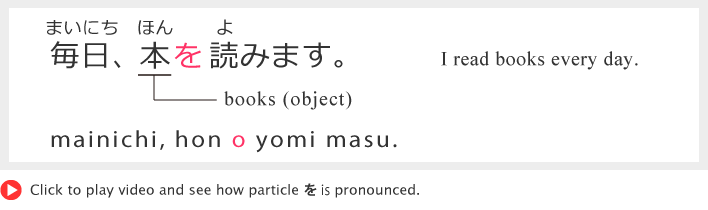
Pronunciation of を is the same as お[o]. Letter を is used only as the particle in a sentence.

In Japanese, ん is counted as one syllable. It should be pronounced for the same length as other letters.

Page Top

Writing

a

The last part should be curved properly.

Note that only the last parts differentiate ね, れ and わ.

i

Look closely the shape of the line 2.

The lines 2 and 3 should be crossed at the right place.

u

Tilt the first straight part properly.

Unlike え, the last part is going upwards.

Page Top

Typing

Hiragana
Keystrokes wa wo nn (n)

Basically, the keystrokes for ん is [nn].

But in some cases, that can be [nn] and [n]. The following are the rules.

  1. If ん is followed by あ-row, な-row or や-row letters, it has to be [nn].
  2. If ん is at the end, it has to be [nn].
  3. If the above two conditions don't apply, it can be [nn] and [n].

To make it simple, just remember that [nn] is always correct and [n] can be wrong sometimes.

Examples

Hiragana Correct Keystrokes Wrong Keystrokes (outcome)
tanni tani (たに)
minnna minna (みんあ)
kinnyou kinyou (きにょう)
そうし soushinn soushin (そうしn)
こう kennkou / kenkou
Page Top

Particle を は へ

Particle is a grammatical term - like verb, adjective, etc...

Each particle has a specific function. For example, particle は indicates that the previous word is the subject of the sentence.

Pronunciation

Hiragana
Pronunciation o (same as お) wa (same as わ) e (same as え)

Pronunciation of is the same as [o].

Letter [ha] and [he] are pronounced differently when they are used as the particle.

Please Note

Texts are usually written in mixture of Kanji, Hiragana and Katakana. And there is no space between words.

In this program, words are separated by space when it is written only in Hiragana.

Page Top

Marks

Japanese Marks
Pronunciation , (comma) . (period) [ ] ? !

Above table shows the keystrokes to input Japanese marks by the English keyboard.

Punctuation marks [、] and [。] have the similar function as English comma and period.

Quotation marks are [「] (beginning) and [」] (end).

[?] and [!] are commonly used. The keystrokes are the same as English.

Page Top

Drill Exercise

Drill. A Drill. B Drill. C

Drill C is designed to train typing ability. In Japanese text input method, keystorokes for some characters are different from the Rōmaji spelling.

For example, to input the letter "ん", you have to type "nn" in many cases. To avoid confusion, please double-check the rules.

Bug Report

Please kindly report if you experienced any problems or bugs. We will fix it right away.

Which drill has the problem?


What kind of problem?


Details:

Details:

Details:

Details:

Which OS do you use?


Which browser do you use?

ver. ver.

Comment / Suggestion / Request:

Page Top

Hiragana Master Drill: Part...

1 | 2 | 3 | 4 | 5 | 6 | 7 | 8 | 9 | 10 | 11 | 12 | 13 | 14 | 15